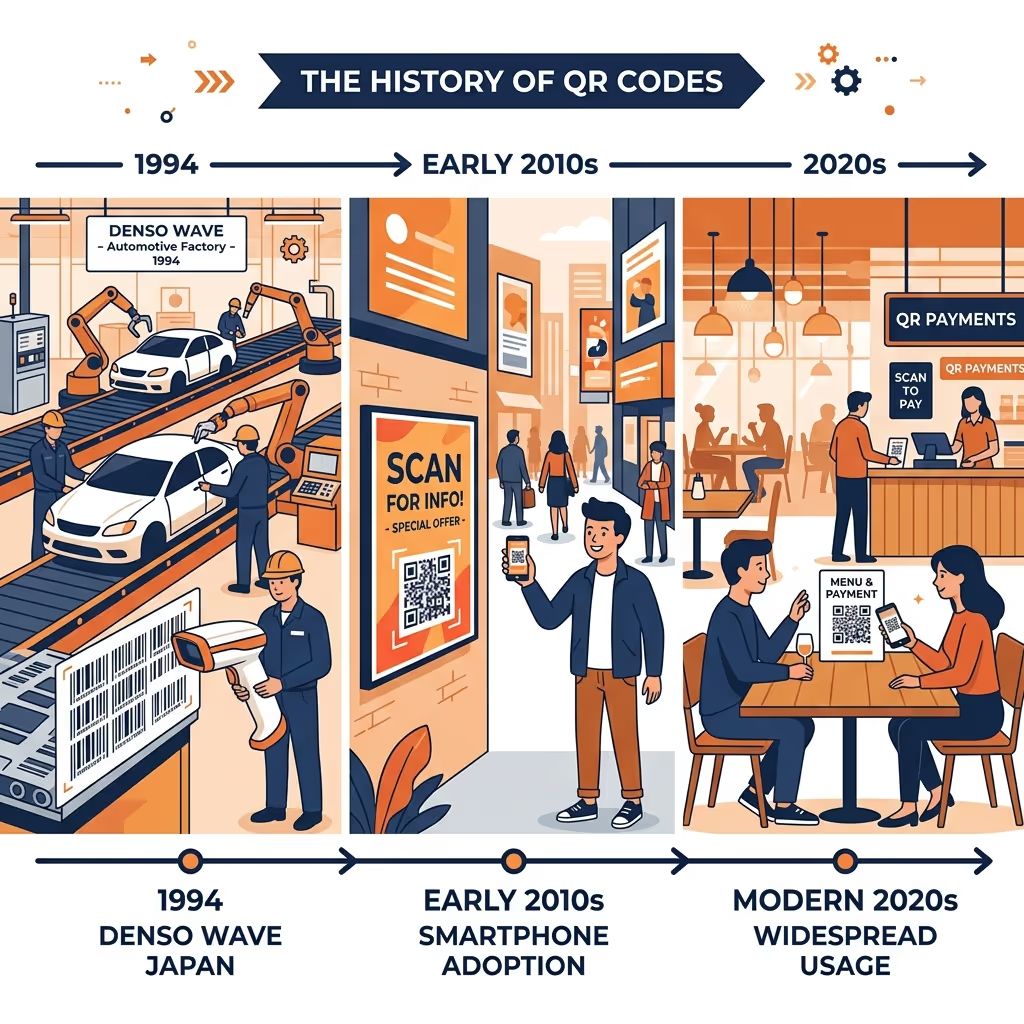
It Started on a Factory Floor
In 1994, a Japanese engineer named Masahiro Hara was working at Denso Wave, a subsidiary of Toyota. His team had a problem: traditional barcodes could only store about 20 characters of data. That wasn’t enough to track the thousands of components moving through Toyota’s manufacturing lines.
Hara’s solution was a two-dimensional code that could be scanned from any angle, at high speed, even when partially damaged. He called it the “Quick Response” code. The QR code was born.
Why QR Codes Almost Died
For the first decade, QR codes stayed inside factories. They were used to track car parts, manage inventory, and speed up assembly lines. Regular consumers never saw them.
That changed around 2010 when smartphones started shipping with cameras. Marketers got excited and started slapping QR codes on everything: billboards, magazine ads, cereal boxes, even gravestones. The problem? You needed a separate app to scan them, the codes usually linked to unoptimized websites, and most people didn’t understand what they were for.
By 2013, QR codes had become a punchline. Tech writers were writing obituaries. The consensus was clear: QR codes were dead.
The Pandemic Changed Everything
Then 2020 happened.
COVID-19 forced businesses to eliminate shared physical objects. Suddenly, paper menus, printed brochures, and shared touchscreens were health risks. QR codes offered a contactless alternative, and this time, the technology was ready.
Apple had added native QR scanning to the iPhone camera in iOS 11 (2017). Android followed suit. No more third-party apps. You just pointed your camera and tapped.
Restaurants adopted digital menus overnight. Payment systems like WeChat Pay and Alipay (already huge in China) proved that QR-based payments could work at scale. Even the Super Bowl started featuring QR codes in TV commercials.
QR Codes Today
By 2025, QR codes are a permanent part of daily life:
- Payments: QR-based payments are standard across Asia and growing fast in Europe and the Americas
- Authentication: Two-factor auth apps use QR codes for setup
- Digital menus: Roughly 60% of restaurants adopted QR menus during the pandemic, and most kept them
- Product packaging: Brands use QR codes for ingredient lists, sustainability info, and loyalty programs
- Events: Concert tickets, boarding passes, and conference badges all rely on QR codes
- Marketing: Dynamic QR codes let marketers track engagement and swap destinations without reprinting
The Technology Behind the Squares
A QR code is a matrix of black and white modules arranged in a square grid. Here’s what makes them work:
Position markers: The three large squares in the corners help scanners detect the code and determine its orientation. This is why QR codes can be scanned from any angle.
Error correction: QR codes use Reed-Solomon error correction. Even if up to 30% of the code is damaged or obscured, it can still be read. This is what makes it possible to place a logo in the center.
Data capacity: A single QR code can store up to 4,296 alphanumeric characters. Compare that to a traditional barcode’s 20.
Encoding modes: QR codes support four modes: numeric, alphanumeric, byte, and kanji. The encoder automatically picks the most efficient mode for your data.
Static vs Dynamic: The Modern Evolution
The original QR codes were static. The data was encoded directly into the pattern. Once printed, they couldn’t be changed.
Dynamic QR codes are the modern evolution. Instead of encoding the final URL, they encode a short redirect link. A server handles the redirect, which means you can:
- Change the destination without reprinting
- Track who scanned it, when, and from where
- A/B test different landing pages
- Pause or expire codes on a schedule
This is the technology that powers platforms like EverQR.
What’s Next?
QR codes aren’t going anywhere. If anything, they’re getting more capable:
Smaller codes: Micro QR and rMQR (rectangular) variants are designed for tiny surfaces like electronic components.
Colored and branded codes: Custom colors, dot patterns, and embedded logos are becoming standard. A branded QR code gets scanned more often than a plain black-and-white one.
Integration with AR: Some companies are experimenting with QR codes that trigger augmented reality experiences when scanned.
Offline-first: New encoding standards allow QR codes to carry entire web pages, forms, or apps, no internet connection required.
Create Your Own
Three decades after Masahiro Hara solved Toyota’s inventory problem, you can create a professional QR code in about 30 seconds. Try it with EverQR’s free generator, or sign up for EverQR Pro to unlock dynamic codes with analytics.